With transcripts from video (“Belmont Mine – The world’s third-largest emerald mine – Why the sudden shift to selling mostly rough emeralds”) produced by Andy Lucas, President, Guild Institute of Gemology – with field insights from the Guild Field Gemology team and former ICA President Clement Sabbagh.
A Legacy of Vision and Consistency by Belmont Emeralds
Deep in the hills of Itabira, Brazil, the Belmont Emerald Mine stands as one of the world’s most admired and technologically advanced colored gemstone operations. Discovered in 1978 — quite literally by accident — Belmont has evolved into a global model of sustainability, innovation, and precision.
Owned and managed by the same family for nearly five decades, Belmont has remained true to its philosophy of continuous reinvestment in research, equipment, and people. The result is a mining operation that not only produces some of the finest emeralds in the world but also exemplifies what responsible mine-to-market practices can achieve when vision meets long-term strategy.
“Belmont understands their emerald deposit better than any other colored gemstone mining operation in the world,” says Andy Lucas, President of the Guild Institute of Gemology. “They can adjust production, target specific qualities, and bring precisely what the market demands — a rare mastery in this industry.”
From Optical Sorters to Laser Precision
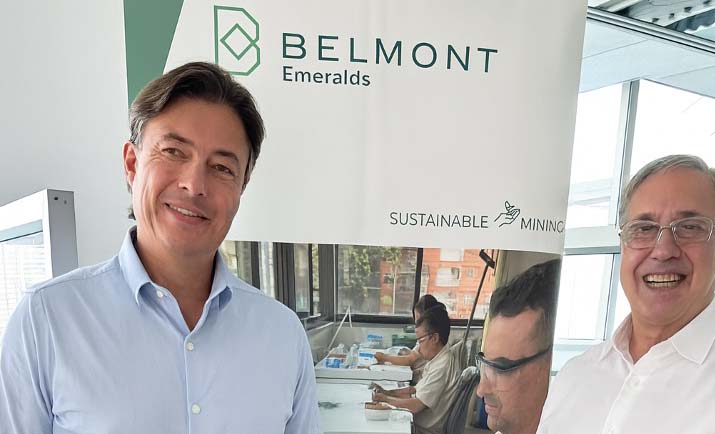
During recent Andy Lucas Guild visit with CEO Marcelo Ribeiro and Clement Sabbagh – former ICA President, they witnessed how Belmont continues to lead through technology.
The mine was among the first in Brazil to implement optical sorting — a breakthrough that revolutionized the efficiency of emerald processing. Today, Belmont has taken another leap forward with advanced laser sorters that significantly increase ore-processing capacity.
Combined with new mechanized drilling machines that operate twice as fast as their predecessors, Belmont is optimizing both yield and safety. Each tunnel now runs deeper and longer, while a new open-pit zone has been prepared for future extraction, ensuring decades of continued production.
Adapting to Market Cycles: The Shift Toward Rough Emeralds
Over the years, Belmont has shown remarkable agility in adapting its business model to global market conditions. Historically, the company operated a sophisticated cutting factory — often described as “The De Beers of Brazil” — producing world-class faceted emeralds near the mine site.
At one point, 60–65% of Belmont’s output by value was cut stones, requiring tens of millions of dollars in inventory. But the post-COVID market brought an unprecedented rise in rough emerald prices, prompting Belmont to strategically refocus.
Today, the company’s attention is back on rough production and auction-based sales, a model that maximizes liquidity and allows faster reinvestment in mining operations.
As CEO Marcelo Ribeiro explained, “When you fill an order for a brand like Cartier, you might have to cut 100 stones for them to choose 20 — which ties up capital. Selling rough through auctions ensures almost everything moves, and the revenue goes directly back into improving the mine.”
Scaling Emerald Production and Global Reach
Belmont now produces around 500 kilograms of rough emerald per year, cutting only a small fraction — about 10 kilograms — for internal research and select projects. Their previous auction showcased 200 kilograms of material; the next, scheduled for November 2025, will feature an estimated 300 kilograms, marking their largest and most diverse offering yet.
Only about 10% of this production qualifies as top-grade vivid green emeralds (A, B, and C grades). The remainder comprises commercial-quality material suited for a range of applications — from fine jewelry to cabochons and beads — reaffirming that even in large-scale production, fine emeralds remain exceptionally rare.
A Dynamic Gemstone Global Market
Belmont’s auctions attract a truly international clientele, with strong participation from Jaipur’s renowned emerald cutters, as well as buyers from the United States, Europe, and the Middle East.
While demand from China has softened in recent months — with no Chinese buyers at their most recent auction — the global market for responsibly sourced rough emeralds remains vibrant. In particular, India’s appetite continues to surge, reflecting the country’s growing role as a central hub in the colored-gemstone trade.
A Model of Responsible and Intelligent Emerald Mining
What makes Belmont stand out is not just its production volume, but its commitment to the full mine-to-market ecosystem. From geological research and on-site cutting expertise to transparent grading and ethical business practices, the company represents one of the most complete emerald operations in the world.
“I have studied this mine for many years,” adds Lucas. “And I continue to be amazed by their leadership, forward thinking, vision, and business methodology. Belmont remains one of the finest colored gemstone mining models in history.”
Looking Ahead
As Belmont Emeralds continues to expand production, invest in technology, and strengthen its auction platform, it reaffirms its position as a global leader — one whose innovation, transparency, and sustainability set new standards for the gemstone industry.
With the world’s eyes once again on Brazil, Belmont’s story is more than a success; it’s a blueprint for the future of responsible emerald mining.
About Andy Lucas
President, Guild Institute of Gemology
Andy Lucas is an internationally recognized gemologist, educator, and field researcher. He has documented and analyzed gemstone production around the world for over two decades, focusing on innovation, sustainability, and mine-to-market integration.
Reference: Original video posted on Instagram – “Belmont Mine – The world’s third-largest emerald mine – Why the sudden shift to selling mostly rough emeralds”